

Texts
Bio
Kaisaleena Halinen (born 1973 in Turku, Finland) is a visual artist. Halinen works with sculpture, installations and site-specific pieces.
She graduated in 2002 from the Department of Time and Space in the Academy of Fine Arts, Helsinki, Finland.
She uses a diverse range of materials, choosing specific techniques and materials for each work. Materials include marble, dust, wood, plaster, silicon, photography, metals, textiles, recycled materials and everyday utensils.
In her most recent works, Halinen has explored the role of human beings as consumers and modifiers of nature. These works consist of memories and observations, but also comment on dark predictions for the future. Halinen plays with the borders of reality and fiction. Whilst everything looks comfortingly ordinary, some aspect of the work evokes feelings of things not being quite right.
StickyBio
MOURNING | Hannu-Pekka Björkman
Layer by layer, piece by piece, a human being is created and formed. In the same way, we also depart—piece by piece, layer by layer. For a moment we exist in candle flames, in fragrant beeswax, in thin smoke. Fragments of our existence remain in the thoughts of the living, in photographs, and on gravestones. Movement is continuous as great gates are opened and closed. Do we exist only as long as we are remembered?
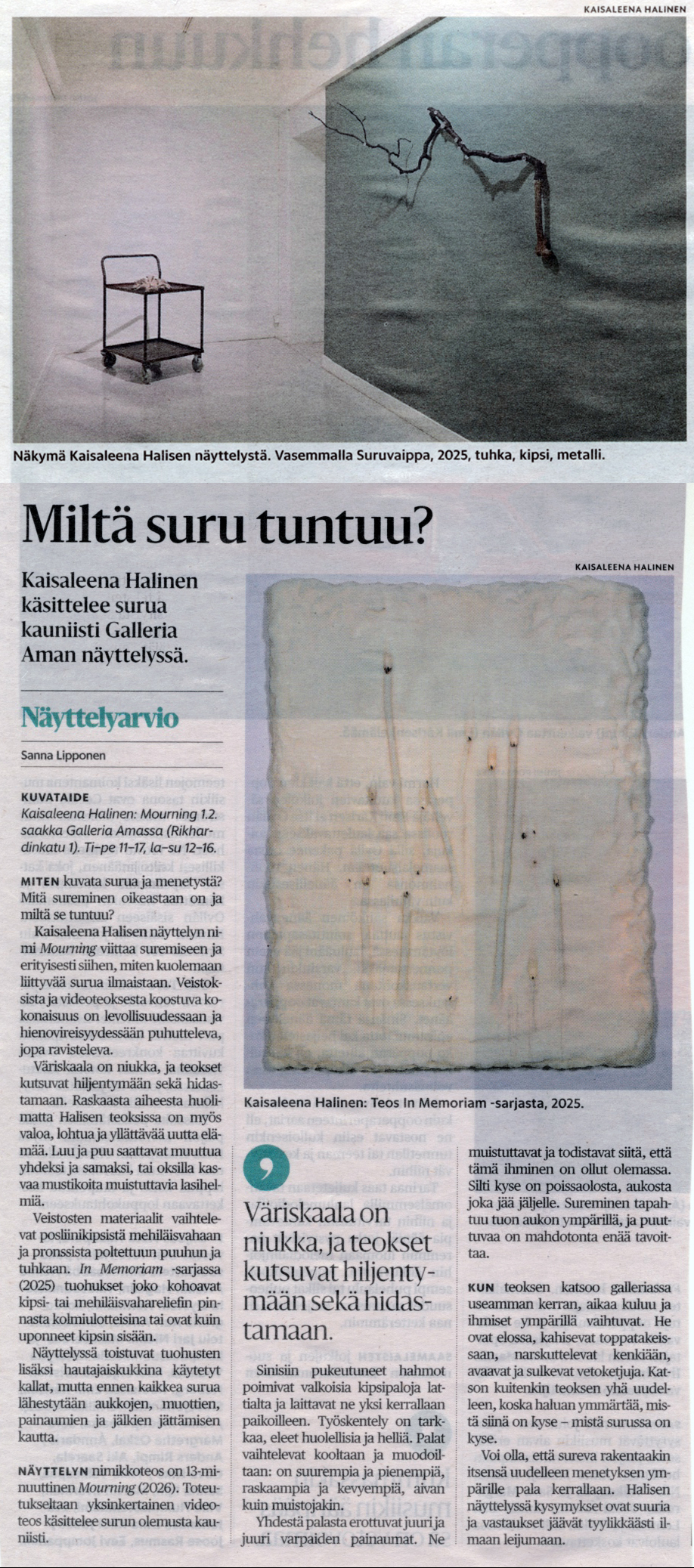
The works in Kaisaleena Halinen’s new exhibition are dominated by elements of existence and transience. One of her starting points has been Hans Holbein the Younger’s painting Der tote Christus im Grab (The Dead Christ in the Tomb, 1521–1522). It is a painting that deeply unsettled Fyodor Dostoevsky when he visited the Basel Art Museum in 1867. Measuring two meters in width and thirty and a half centimetres in height, the work is disconcerting already by its proportions alone. Dostoevsky’s wife, Anna Grigorievna, wrote in her memoirs about her husband’s reaction before the painting: “He stood motionless for twenty minutes, and it was evidently difficult for him to control himself. His agitated expression foretold the onset of an epileptic seizure.” Dostoevsky returned to the painting in his novel The Idiot, where Prince Myshkin exclaims upon seeing the work: “That painting could make some people lose their faith.” Holbein’s painting is realized at the intersection of the experience of human death, the inexorable laws of nature, and Christianity. In a similar way, different elements intersect in Kaisaleena Halinen’s works. Bone and charred wood have grown together. In decomposing, slowly vanishing parts of organisms, ice-like glass berries grow—signs of living matter. Calla lilies, the stately flowers of death, formed from ash, travel in their black carts. In the reliefs, candles burn; memories, thoughts, and prayers for the absent are embedded in plaster and beeswax.
Every grief is different, every loss and longing forms its own universe. We are built as much from what is unattainable as from what has been attained. We are shaped by losses, renunciations, and yearning. When a person—someone we may at times have taken for granted as ordinary—leaves us, they become ever-present. Gradually, our memory constructs its own story of them, shaping them from fragments and parts that may be true. True or not, the human figure remains.
If Holbein’s painted dead Christ, through his humanity, caused someone to doubt his divinity, are we capable of seeing divinity in the humanity of the deceased? I cannot say. I do not know the answer. The Hungarian writer Imre Kertész wrote: “The only path to freedom passes through memory.” In Kaisaleena Halinen’s works, the gates of memory are slightly opened. Each of us builds our own memories until it is others’ turn. Then we become a trace in time, an imprint in plaster. Let us hope that at that moment gentle hands will carry us.
Hannu-Pekka Björkman
actor–writer
StickyTexts

STRONG WORKS ABOUT FRAGILITY | Marja Sakari
STRONG WORKS ABOUT FRAGILITY
Kaisaleena Halinen has described the strong influence that a past incident has had on the works of the current exhibition. During the Summer Exhibition of 2019 in Riihimäki, somebody broke into the exhibition hall and demolished many of the works. A ceramic bust of a little girl had been shattered by a blow on the forehead. The artist only realized the violence and the weight of the act later when she was repairing the bust. Halinen decided to change her plans for the upcoming exhibition and put aside the works she had already started to work with. It felt more meaningful to let out the ideas that had started to emerge due to this broken and repaired bust.
The art of Kaisaleena Halinen is delicate and fragile, but it arouses strong, intimate sensations. In the current exhibition in Galleria Ama, Halinen continues with her deep, profound reflection on humanity, power, violence, fragility and shame. Changes in the fragile surface of the delicate ceramic sculptures evoke, through connotations, strong and almost physical sentiments.
In a video work called Sinelmä/Bruise, a reddish patch resembling a bruise starts to emerge in a cheek of ceramic head of a woman. In a viewer’s mind, it conjures up images of domestic violence, oppression and control over others. When the patch spreads, you start to notice cracks, net-like craquelures, on the ceramic surface. The paradoxical beauty of the hairline fractures reinforce the sense of threat and malice.
Halinen uses these fractured surfaces, produced by a matt white craquelé glaze, as an effect also in many other works of this exhibition. The closed eyelids of the piece called Näkijä/Seer are covered with a network of hairline fractures. The lips of the adjacent heads in Requiem are cracked. Human life and human relationships are brittle, fragile and shattered. The ceramic heads become associated with death masks. The surface of some of the sculptures is treated in part with ink, that makes the hairline fractures stand out. This conjures up an image of a subcutaneous, self-determining and otherwise invisible energy.
Halinen has examined the ways ceramics behave, for example, by filling a hollow cast head with water (Waves), and by soaking ceramic feet in water containing ink and coffee (Herkistyminen/Sensitization). The feet absorb water and darken. These changes Halinen has recorded in her videos. In the gallery, the three videos are projected each on their own wall. The realistic effect is increased by the fact that the objects are life-size: the feet are the size of human feet, the head is the size of a human head. The impression of blushing in a piece called Waves has been achieved by first adding a small amount of red pigment to the casting slip. When the burnt sculpture gets wet, it turns darker and ”blushes”. The hollow sculpture has been filled with water when upside down, so blushing seems to rise from the inside.
In the video piece Sinelmä/Bruise, where a bruise emerges on a woman’s face, it starts as red and very small but expands and turns bluish. Some inks can penetrate a ceramic surface and colour it. The ceramic material lets through the red colour in the ink first, and after that, the blue.
In a small back room of the gallery, there is a torso of a man lying on a low pedestal. A video of a stone being thrown through thin ice is projected on the torso. The ice appears to form a skin on the torso, which is then broken by the stone. From under the ice, water wells up like blood or some other bodily fluid. The sound of the breaking ice accentuates a feeling of pain and agony.
In the field of art in Finland, there is a lively debate going on about the meaning of art and its purpose. Should art be used for making a statement or should it keep to its own values? In a critics’ journal, Kritiikin uutiset, Olli Ahlroos writes about experiencing art and being touched by art. He says: ”Experiencing art is a rare and improbable event that takes place in the presence of exceptional works of art.”
Ahlroos is referring to the thinking of Gilles Deleuze, for whom great art is political. For Deleuze the political nature of art does not depend on the artist’s political views but it is a question of quality. ”A great work of art is political, because, according to Deleuze, that is what an act of creating by definition is. An artist should create, not ‘reflect’ reality or convey reactive ‘information’”. Creating something new is political, because it forces something unprecedented and uncontrollable on the surface of an artwork, on its structures and on the surrounding reality. A creative act opens, by way of the surface of the artwork and through it, a possibility to experience something, that the existing political parties and ideologies cannot bring under control in their system. Only creating something uncontrollable is ”an act of resistance” according to Deleuze.”[1]
Experiencing art is a rare and improbable event that takes place in the presence of exceptional works of art. This kind of event can be experienced looking at the works of Kaisaleena Halinen.
Marja Sakari
PhD, Director of Ateneum Art Museum
[1] https://www.kritiikinuutiset.fi/2019/12/15/kasittamaton-taide-osa-2-luomistekojen-etiikasta/?fbclid=IwAR1Q_u1AvKol4jPwYmD8FxKI0KTJrFgUey9MyF2mCYu4OL_ekHB4eCah1fw
StickyTexts
- 1
- 2